Most people picture the universe as a vast collection of galaxies, stars, and planets. These objects dominate photographs from powerful telescopes, so it’s easy to assume they contain most of the matter that makes up the cosmos. Yet only a small fraction of the universe’s ordinary, atom-based matter actually sits inside these bright structures. The rest is scattered across regions that appear almost empty at first glance.
Understanding where this matter hides has been a long challenge in astronomy, and recent research has finally brought the full picture into focus.
The Small Share Held by Stars and Galaxies
The Big Bang model predicts that about 5% of the universe is made of atoms—protons, neutrons, and electrons. On the surface, stars seem like the obvious place to find them. Galaxies contain hundreds of billions of stars, and astronomers estimate roughly 10²³ stars exist across the observable universe. That’s hundreds of times more than every grain of sand on Earth. Even then, the total number of atoms locked inside stars falls short.
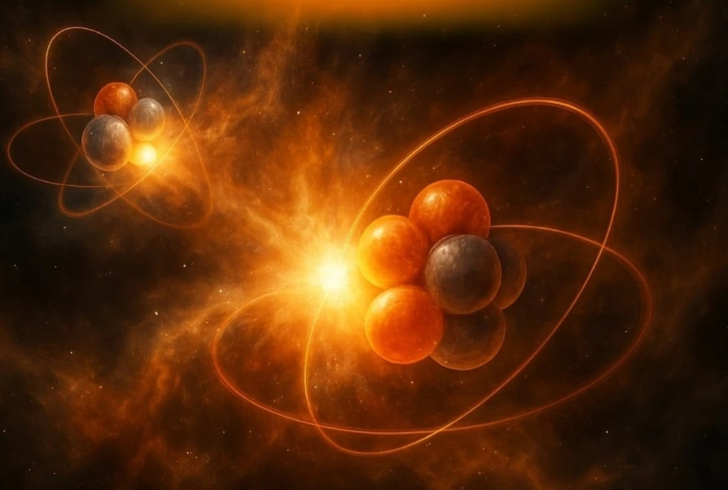
Instagram | sciencewithjahir | The Big Bang predicts 5% of the universe is atoms, but stars contain only a fraction.
Key figures often surprise readers:
1. Stars hold only about 0.5% of the universe’s matter.
2. Around 0.03% consists of heavier elements such as carbon and oxygen—the materials that form planets and living organisms.
3. The universe contains an estimated 10⁸² atoms, yet most aren’t inside any visible structure.
These numbers leave an enormous amount of ordinary matter unaccounted for—matter that must exist somewhere beyond the bright cores of galaxies.
The Vast Reservoir Between Galaxies
The most likely hiding place is the intergalactic medium, the enormous expanse separating one galaxy from another. While often described as a vacuum, this region is far from empty. It holds a network of faint, wispy filaments called the cosmic web. Even though its density averages only one atom per cubic meter—a level far thinner than anything on Earth—the sheer scale of the universe gives this matter significant weight.
This medium also reaches temperatures of millions of degrees, making it glow primarily in X-rays. Most X-ray telescopes lack the sensitivity needed to map this thin, hot gas with precision, which is why so much ordinary matter remained undetected for decades.
Radio Bursts as a New Measuring Stick
A breakthrough came from studying mysterious cosmic signals known as fast radio bursts (FRBs). These bursts release as much energy in a single millisecond as the Sun emits in three days. Since their first discovery in 2007, researchers have traced them to the surroundings of ultra-dense neutron stars.
A specific type, called a magnetar, is believed to generate many of these bursts. Magnetars possess magnetic fields a thousand trillion times stronger than Earth’s, making them some of the most extreme objects known.
As FRBs travel across the universe, electrons in intergalactic gas slow the longer wavelengths of their radio waves. This stretching of the signal acts like a measurement tool. By analyzing how much the wavelengths spread, astronomers can estimate how much gas each burst passed through on its journey to Earth.
Completing the Inventory of Ordinary Matter

edition.cnn.com | Fast radio bursts confirm the Big Bang model’s predicted 5% distribution of normal matter.
A major study released in June 2025 by scientists from Caltech and the Harvard Center for Astrophysics used 69 fast radio bursts collected with an array of 110 radio telescopes in California. Their findings clarified where the universe’s matter is distributed:
1. 76% lies in the intergalactic medium.
2. 15% resides in halos around galaxies.
3. 9% sits inside galaxies as stars and cold gas.
This distribution matches the Big Bang model’s predictions almost exactly. Recovering the expected 5% of normal matter serves as a powerful confirmation of the theory’s accuracy.
As new radio telescope arrays come online, the number of detected bursts is expected to rise to 10,000 per year. With such large samples, FRBs may soon help map the three-dimensional structure of the cosmic web itself.
What About the Rest of the Universe?
While the picture of ordinary matter is now complete, most of the cosmos remains composed of substances that still defy explanation. Dark matter, accounting for roughly 27%, behaves like an invisible scaffold that shapes galaxies. Its presence becomes clear through gravitational lensing, where unseen mass bends light far more strongly than visible matter can. This effect indicates that dark matter outweighs normal matter by more than five times.
Then there is dark energy, the mysterious force pushing the universe to expand faster over time. Together, these components dominate the cosmic recipe, yet remain poorly understood.
Ordinary matter—everything made of atoms—forms only a tiny slice of the universe, and most of it floats between galaxies rather than inside them. Thanks to fast radio bursts and new observational techniques, astronomers can now trace this hidden material with clarity.
While questions about dark matter and dark energy continue, a major cosmic puzzle has been solved: the universe’s missing atoms are no longer missing at all.